

Education has two constraints nobody else has: departments that won't share a flat register, and borrowers who are students rather than staff. Solve those with departmental separation and self-service requests, and term boundaries become natural audit points.
The first thing a college IT manager said to me on a call last term was: "The media school won't use anything the science faculty can see."
That wasn't territorial. It was practical. A flat register listing four hundred laptops alongside six hundred lab items is useless to both of them, and any system that forces it gets abandoned by whichever department was less enthusiastic.
Constraint one: departments need separation inside one system
You want one contract, one set of labels and one place to look. Each department wants to see only their own equipment and manage it their own way.
Those aren't in conflict if departments and roles are first-class — each faculty manages its own register, sees its own equipment, and the institution still gets a single view when it needs one. Without that separation, what you actually get is three systems and a spreadsheet, which is where most institutions start.
Constraint two: the borrowers are students
Students are numerous, transient, and not staff. Any loan process that depends on a member of staff being at a desk during office hours doesn't survive a term — it becomes a sign-out sheet on a clipboard within a fortnight.
What works is a request the student can make from a phone, an approval from whoever holds that permission, and the approval creating the custody record with a signature. The accountability trail comes out as a by-product rather than as extra work for a technician.
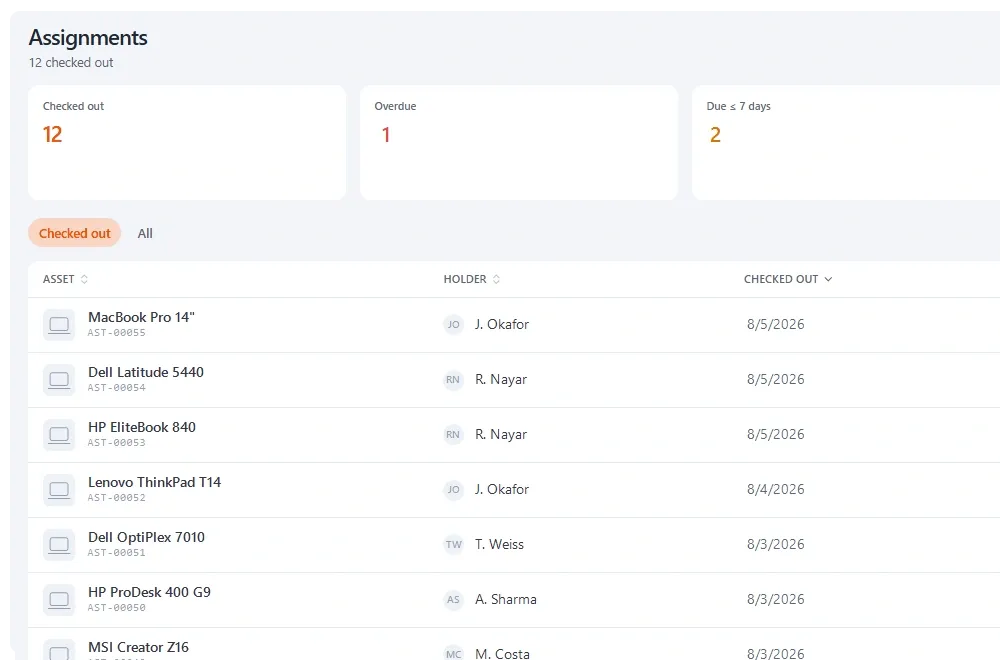
*Loans as custody records rather than sheet entries — with a name, a date and a due date that means something.*
The three shapes an institution actually has
|
Pattern |
Example |
What it needs |
|---|---|---|
|
Short loan to a student |
A laptop for a project week |
Self-service request, approval, signature, due date |
|
Long allocation to staff |
A laptop for the academic year |
Custody with no due date, reviewed annually |
|
Room or trolley equipment |
A cart of tablets in a classroom |
Location-based, counted termly, no individual holder |
The third is the one institutions forget to plan for and the one that quietly loses the most, because nothing is ever formally issued and nobody is accountable between counts.
Making requests work at student volume
- Set clear categories. A student browsing four hundred items abandons; a student browsing 'laptops' books.
- Auto-approve the low-value tiers. If a technician would always say yes, the approval step is a delay that teaches people to ask in person instead.
- Put the due date in the confirmation, not just in the system. Most late returns are genuinely forgotten.
- Send a reminder before the due date. One message, a day before, recovers more equipment than any amount of chasing afterwards.
Term boundaries are the audit you already have
End of term is when equipment is meant to come back and quietly doesn't. It's also the last point at which the student is still contactable, which makes it the single most valuable moment in the academic year to run a count.
|
When |
What to do |
Why then |
|---|---|---|
|
Start of term |
Issue against names, with signatures |
Sets the baseline you'll count against |
|
Mid-term |
Nothing — let it run |
Interrupting for admin trains people to route around it |
|
End of term |
Scoped count per department |
Last point the borrower is contactable |
|
Vacation |
Chase, service, reconcile |
The only time equipment is still long enough |
Equipment that leaves the site
Devices going home with students or staff are a different risk from anything in a store cupboard, and usually the largest exposure an institution has.
- Record the loan with an end date, tied to the term or academic year rather than an arbitrary period.
- Get an acknowledgement, from a parent or guardian for younger students, listing what went out including the charger.
- Set the return expectation at issue. Most non-returns are people who never registered that it had to come back.
- Chase before the end of term, while the student is enrolled. Afterwards it's a write-off with extra steps.
Grant-funded equipment
Equipment bought under a grant usually has to be reported on separately, sometimes returned or transferred at the end, and occasionally evidenced mid-term.
Tag it — a category, a department or a custom field — at the point it's registered, not later. Reconstructing which of four hundred items came from which funding stream three years on is a genuinely miserable week, and I've watched someone do it.
The pricing point that decides it
Per-user pricing doesn't survive a student body. Institutions look at a per-seat model, work out what it costs to let students request equipment, and stop the evaluation there.
Worth checking early rather than late. If a tool charges per user, the practical outcome is that students never get access, technicians enter everything second-hand, and the loan records are always slightly wrong.
Key takeaways
- Departments need genuine separation inside one system, or you end up with three systems and a spreadsheet.
- Student loans need self-service requests — anything requiring staff at a desk becomes a clipboard within a fortnight.
- Plan explicitly for room and trolley equipment: no holder, location-based, counted termly.
- End of term is the highest-value moment to count, because the borrower is still contactable.
- Per-user pricing doesn't survive a student body — check it before anything else.
Frequently asked questions
How do schools track equipment across departments?
With departmental separation inside a single register, so each faculty manages and sees only its own equipment while the institution retains one view. A flat shared register is the most common reason departments abandon a system.
Can students borrow equipment without staff involvement?
Yes, through a request-and-approve flow a student can use from a phone. The approval creates the custody record with a signature, so accountability is produced as a by-product rather than as extra work for a technician.
How do you recover equipment at the end of term?
Run a scoped count per department at the term boundary, while borrowers are still contactable. Each student's record lists what they hold, so recovery is a checklist rather than a search. The same exercise in September is a write-off exercise instead.
How should grant-funded equipment be tracked?
Tag it at the point of registration with a category, department or custom field identifying the funding stream. Reconstructing which items came from which grant years later is extremely painful and sometimes impossible.
Is asset management software affordable for schools?
It depends entirely on the pricing model. Per-user pricing rarely works where students need access. Look for unlimited users, and check whether a free tier covers a single department so you can prove the approach before committing budget.
How do we handle laptop trolleys and class sets?
As location-based equipment with a termly count, rather than assigning them to an individual. Nothing is formally issued, so custody doesn't apply — but that also means nobody is accountable between counts, which is why the count matters.