
Equipment tracking & checkout
Stackroom vs itemit
itemit is a straightforward UK-built asset tracking app with QR, barcode and RFID tagging and a genuinely easy first hour. Stackroom covers the same tagging ground and puts more weight on custody, bookings, maintenance and audit.
Stackroom vs itemit: which should you choose?
itemit is the better choice if you want simple asset tagging with RFID support and minimal setup. Stackroom is the better choice once tracking alone is not enough — when you need signed custody, bookings with availability checks, maintenance tickets and cycle counts with sign-off.
Side by side
Stackroom vs itemit: pricing, limits and features
Grouped so you can jump to the part you care about. Our figures come from our billing API, so they match the invoice.
Pricing & plans
Free plan
- Stackroom
- Free forever — 250 assets, 500 people, unlimited users, no card
- itemit
- None — free trial only (14 days, no card required)
Paid plans start at
- Stackroom
- $35/mo for Starter — published, self-serve
- itemit
- Entry is an annual figure in the hundreds of pounds for up to 1,000 assets and 3 users, with per-user charges beyond that.
How the bill scales
- Stackroom
- Capability and capacity — never headcount, never how much you track
- itemit
- Asset count and user count together. The entry tier caps both; the tier above lifts the user cap but holds the same asset ceiling.
Limits
Asset limits
- Stackroom
- 250 free, up to 10,000 on Premium, custom on Enterprise
- itemit
- 1,000 on the first two tiers · 2,000 on the third · bespoke above 10,000
Users & seats
- Stackroom
- Unlimited on every plan, including Free — seats are never the meter
- itemit
- 3 on entry (pay per user) · unlimited above
Locations & sites
- Stackroom
- 1 on Free, unlimited on every paid plan
- itemit
- Not published as a cap
Custody & accountability
Signed handover & return, with PDF
- Stackroom
- Yes
- itemit
- Assignment
Chain of custody history
- Stackroom
- Yes
- itemit
- Basic
Request → approve checkout
- Stackroom
- Yes
- itemit
- No
Asset clearance certificate for leavers
- Stackroom
- Yes
- itemit
- No
Signed webhooks with retries
- Stackroom
- 41 events, HMAC-signed, retried
- itemit
- Not stated on their pricing page
Audits & compliance
Cycle-count audits with sign-off
- Stackroom
- Yes
- itemit
- Basic
Maintenance & service
AMC / CMC service contracts
- Stackroom
- Yes
- itemit
- No
Finance & lifecycle
Depreciation (SLM / WDV) & book value
- Stackroom
- Yes
- itemit
- Limited
Report library
- Stackroom
- 62 templates
- itemit
- Basic reports
Tracking & tagging
QR & barcode tagging
- Stackroom
- Yes
- itemit
- Yes
RFID tag support
- Stackroom
- No
- itemit
- Its strength
Platform, API & AI
Configurable roles & departments
- Stackroom
- Yes
- itemit
- Basic
REST API
- Stackroom
- Pro and up — documented, published spec
- itemit
- Higher tiers only
Built-in AI assistant
- Stackroom
- Stackroom AI — Starter and up
- itemit
- Not stated on their pricing page
| Capability | Stackroom | itemit |
|---|---|---|
| Pricing & plans | ||
| Free plan | Free forever — 250 assets, 500 people, unlimited users, no card | None — free trial only (14 days, no card required) |
| Paid plans start at | $35/mo for Starter — published, self-serve | Entry is an annual figure in the hundreds of pounds for up to 1,000 assets and 3 users, with per-user charges beyond that. |
| How the bill scales | Capability and capacity — never headcount, never how much you track | Asset count and user count together. The entry tier caps both; the tier above lifts the user cap but holds the same asset ceiling. |
| Limits | ||
| Asset limits | 250 free, up to 10,000 on Premium, custom on Enterprise | 1,000 on the first two tiers · 2,000 on the third · bespoke above 10,000 |
| Users & seats | Unlimited on every plan, including Free — seats are never the meter | 3 on entry (pay per user) · unlimited above |
| Locations & sites | 1 on Free, unlimited on every paid plan | Not published as a cap |
| Custody & accountability | ||
| Signed handover & return, with PDF | Yes | Assignment |
| Chain of custody history | Yes | Basic |
| Request → approve checkout | Yes | No |
| Asset clearance certificate for leavers | Yes | No |
| Signed webhooks with retries | 41 events, HMAC-signed, retried | Not stated on their pricing page |
| Audits & compliance | ||
| Cycle-count audits with sign-off | Yes | Basic |
| Maintenance & service | ||
| AMC / CMC service contracts | Yes | No |
| Finance & lifecycle | ||
| Depreciation (SLM / WDV) & book value | Yes | Limited |
| Report library | 62 templates | Basic reports |
| Tracking & tagging | ||
| QR & barcode tagging | Yes | Yes |
| RFID tag support | No | Its strength |
| Platform, API & AI | ||
| Configurable roles & departments | Yes | Basic |
| REST API | Pro and up — documented, published spec | Higher tiers only |
| Built-in AI assistant | Stackroom AI — Starter and up | Not stated on their pricing page |
Honest take: itemit leads on simplicity and RFID tag support. Stackroom leads on the operational layer built on top of the register.
itemit capabilities verified September 2026 · plan facts read from their pricing page , September 2026. Spotted something out of date? Tell us.
Plan gating
Which tier unlocks what
What you have to be paying for before each capability is available.
- CSV / XLSX importStarter and up
- Barcode & QR scanningStarter and up
- Bookings & reservationsStarter and up
- Maintenance & serviceStarter and up
- Cycle-count auditsGrowth and up
- Report libraryGrowth and up
- Custom fieldsGrowth and up
- Stackroom AIFree and up
- REST APIGrowth and up
- Signed webhooksGrowth and up
- Custom rolesGrowth and up
- Google / Microsoft SSOFree and up
- GPS trackers, handheld RFID and custom asset tags — second tier and above
- Fixed RFID readers and Active Directory — third tier only
- API access sits in the higher tiers
Both have a free starting point, which makes this an easy pair to trial side by side with your own data.
The difference
What Stackroom and itemit are each built to do
RFID is the clearest reason to choose itemit
itemit supports RFID tags alongside QR and barcodes. If you need to read many items at once without line of sight — walking a rack and capturing everything on it in one pass — that is a genuinely different capability and Stackroom does not have it.
Be honest with yourself about whether you need it. RFID means tags, readers and a hardware budget, and it pays off in specific situations: high item density, frequent full counts, items that are awkward to handle individually. For most equipment registers, a phone camera scanning a QR code is faster to deploy and adequate in practice. But when RFID is the right answer it is decisively the right answer, and that should end the comparison.
Where Stackroom adds a layer
itemit is deliberately a tracking app: what do we own, where is it, who has it. Stackroom starts from the same register and adds the operational workflows that surround it.
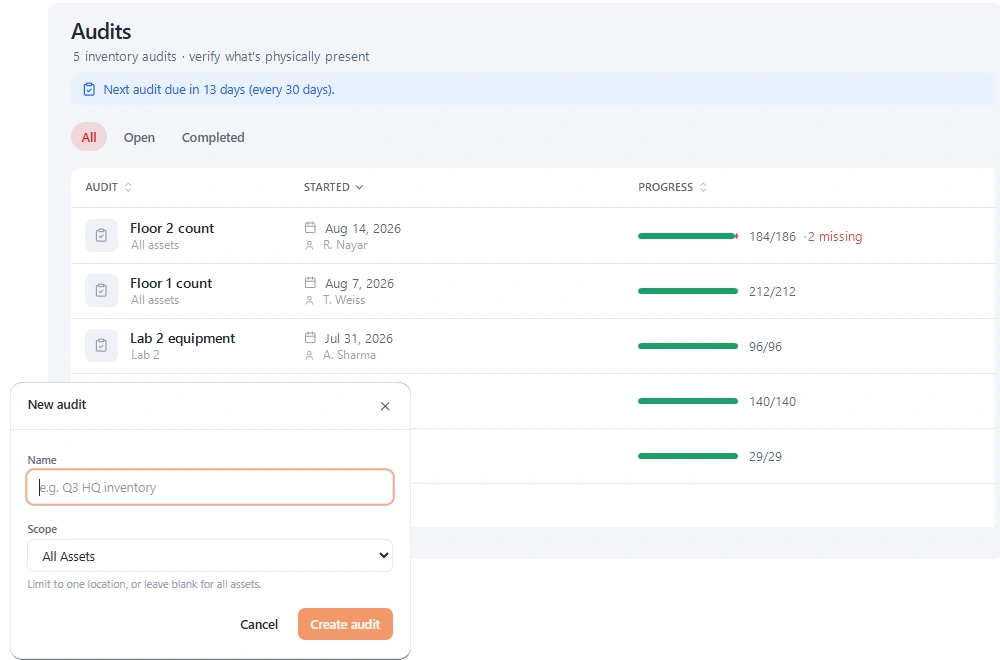
Bookings with availability and overlap checking, so two teams cannot claim the same item for the same Tuesday. Maintenance tickets with statuses and a service history, so a fault becomes tracked work rather than a note. Warranty dates with reminders that fire before expiry. Cycle-count audits scoped to a location, walked on a phone, closed with a signature. Configurable roles and departments so a large organisation can let each team manage its own equipment inside one register.
None of that matters if tracking is your whole problem. All of it matters the moment equipment is shared, serviced, or has to be accounted for to someone outside your team.
Both are easy to start, which makes trialling them cheap
Neither tool requires an implementation project, and both have a free entry point. That is unusual enough in this category to be worth naming, and it means the sensible evaluation is to run both rather than read about both.
Load the same fifty assets into each. Tag them. Do a real handover and a real return. Then try to answer a question you actually get asked — who had the thermal camera in March, what is due for service next month — and see which tool answers it without you leaving the app.
Why teams switch
What we hear from teams leaving itemit
Tracking was solved; sharing was not
Knowing where an item is does not stop two teams needing it on the same day. Bookings with availability checks is the capability teams reach for next.
Faults kept getting lost
A fault noted in a comment is not a tracked repair. Teams move when they want a ticket, a status, an expected return date and a cost against the asset.
The count had to be defensible
A spot check is not an audit. When a finance team or an auditor is the consumer, the count needs a scope, a result set and a signature.
The other side
When itemit is the better choice
We would rather you picked the right tool than picked ours.
- You need RFID. This is the decisive one — Stackroom does not support RFID readers.
- Your requirement really is just tagging and locating, and additional workflow would be unused weight.
- You want the absolute shortest path from signing up to a tagged asset, and nothing beyond that.
- You are UK-based and value a UK-built, UK-supported product specifically.
Switching
Moving from itemit
- 1
Export from itemit
Take a full CSV or XLSX export of your asset list, including serial numbers, categories, locations and any custom fields you rely on. Export your people list separately if itemit keeps one.
- 2
Map the columns once
The importer previews your file and lets you map each column to a Stackroom field. Categories, locations and departments are created from the values in your file, so you do not build the hierarchy by hand first.
- 3
Import people, then assets
Loading people first means custody assignments resolve to a real person on the asset import rather than needing a second pass.
- 4
Check a sample, then go
Spot-check twenty records against the old system before you invite the team. Re-importing is safe — matching on an existing code updates rather than duplicates.
Nothing is deleted from itemit by importing into Stackroom, so you can run both in parallel for a week while people get used to the change.
FAQ
Questions, answered
Does Stackroom support RFID?
No. Stackroom uses QR codes and barcodes scanned with a phone camera. If bulk RFID reading is a requirement, itemit supports it and we do not.
Can we keep our existing QR labels?
Yes, if they carry a code you already track. Import that code as the asset's reference and scanning continues to work. New labels print on standard address stock when you need them.
What does Stackroom add over a tracking app?
Bookings with availability checking, maintenance tickets with history, warranty reminders, signed custody with PDF agreements, cycle-count audits with sign-off, and configurable roles for larger teams.
Is Stackroom harder to set up?
Marginally, because there is more to configure — locations, categories and roles. Most teams are running a real checkout the same day, and the free tier means you can test that claim rather than take it on trust.
Can we import our data from itemit?
Yes. Export your inventory to CSV and import it into Stackroom. Categories, locations and custom fields map across, and our team will help with the awkward parts of a larger migration.
How long does switching actually take?
Most teams import in the morning and run a real checkout the same afternoon. There is no implementation project and no professional services fee. The longest part is usually relabelling, and that can be done gradually.
Do we have to relabel everything?
No. If your existing labels carry a code you already track, import that code and keep using them. New QR labels can be printed on standard address stock as and when you need them.
Is itemit free?
No. itemit has no free plan, only a free trial — 14 days, no card required. Stackroom has a permanent free plan with unlimited users and no card required.
How is itemit priced compared with Stackroom?
Asset count and user count together. The entry tier caps both; the tier above lifts the user cap but holds the same asset ceiling. Stackroom prices on capability and capacity instead: users are unlimited on every plan, and tracking more equipment never moves the bill on its own.
What are the itemit asset and user limits?
Assets: 1,000 on the first two tiers · 2,000 on the third · bespoke above 10,000. Users: 3 on entry (pay per user) · unlimited above. Locations: Not published as a cap. Every Stackroom limit is published on our pricing page and served from our billing API, so it matches your invoice.
Other comparisons
Looking at something else?
Outgrowing itemit?
Import your data, print a sheet of labels, and run a real checkout the same day.