

Professional services firms carry an unusually high ratio of expensive, confidential devices to people. What distinguishes their requirement is evidence: being able to show who held a specific device on a specific date, rather than who holds it now.
In audit work you develop a sense for which control questions are going to be uncomfortable. In professional services firms, one comes up more than any other.
Not "what devices do you have" — most firms can answer that reasonably. It's "who held this one in March, and can you show me?"
That question is asked after something has happened, and the answer is nearly always a shrug, because the register holds a current holder and overwrote everything before it.
Why confidentiality changes the requirement
A missing laptop in most businesses is a replacement cost and an irritation.
A missing laptop holding client matter files is potentially a reportable incident, a professional indemnity question, and a conversation with a client who is also a source of revenue. The first thing anyone asks is who had it and what controls existed around it.
A name in a spreadsheet cell is not a control. It's a value somebody typed, with no date, no evidence the person accepted it, and no record of who had it before. The gap between that and a signed chain of custody is invisible right up until the moment it matters, and then it's the only thing that matters.
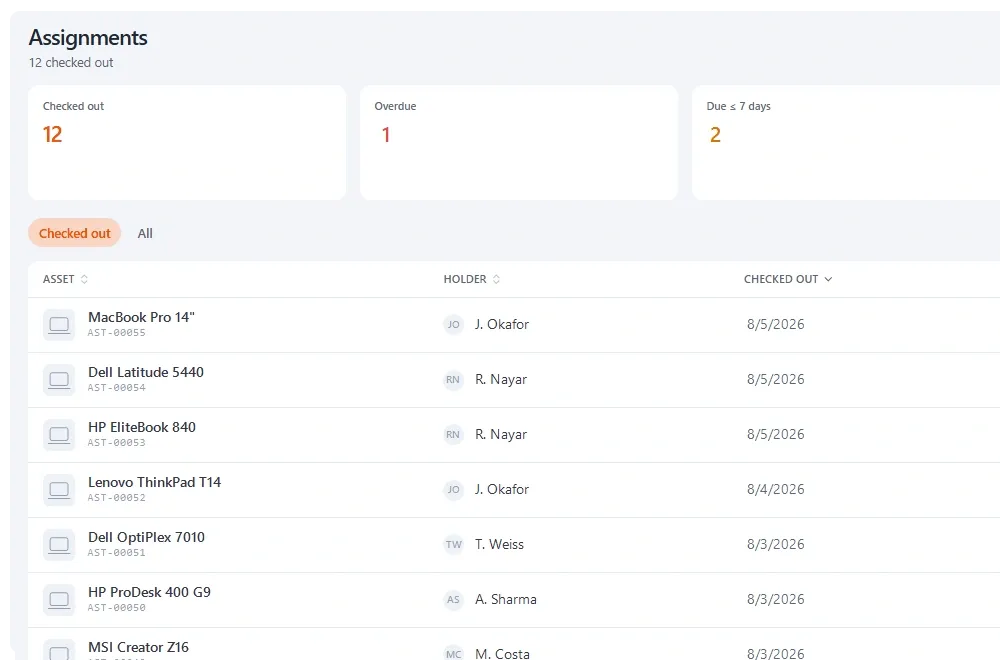
*Every device against a named holder with a date — and the chain retained rather than overwritten.*
What a defensible custody record contains
|
Element |
Why an assessor asks for it |
|---|---|
|
Named individual |
Accountability needs somebody who can be asked |
|
Date of issue |
Establishes the period of responsibility |
|
Evidence of acceptance |
A signature, not an assertion that it was assigned |
|
Condition at issue |
Distinguishes damage from pre-existing wear |
|
Full holder history |
Answers the question about a past date |
|
Closure on return |
Shows the period ended, and when |
Most firms have the first two. The third is what turns a record into evidence, and the fifth is what makes a historical question answerable.
The accessory accumulation nobody budgets for
Partners and associates accumulate equipment across desk moves, home working, office refurbishments and promotions. Two docks, three chargers, a spare monitor and a headset per person is unremarkable.
It rarely triggers a project, because no individual item is expensive enough to notice. Priced across a hundred fee earners it routinely exceeds the laptop estate, and none of it appears in any register — which also means none of it is recovered when somebody leaves.
Departures, and the notice period problem
Professional services has a specific version of the offboarding problem: notice periods are long, departures are often to a competitor, and the conversation is delicate.
Nobody wants to spend the exit interview asking a departing partner to account for a dock. Which means it doesn't get asked, and the equipment stays.
- Generate the list from their record at the start of the notice period, not the end.
- Make it administrative, handled by the same process that covers access revocation and file returns. Nobody negotiates with a checklist.
- Check items in individually with a condition note rather than closing the custody in bulk.
- Close with a signed clearance, which is also the document that answers the question about client data leaving with them.
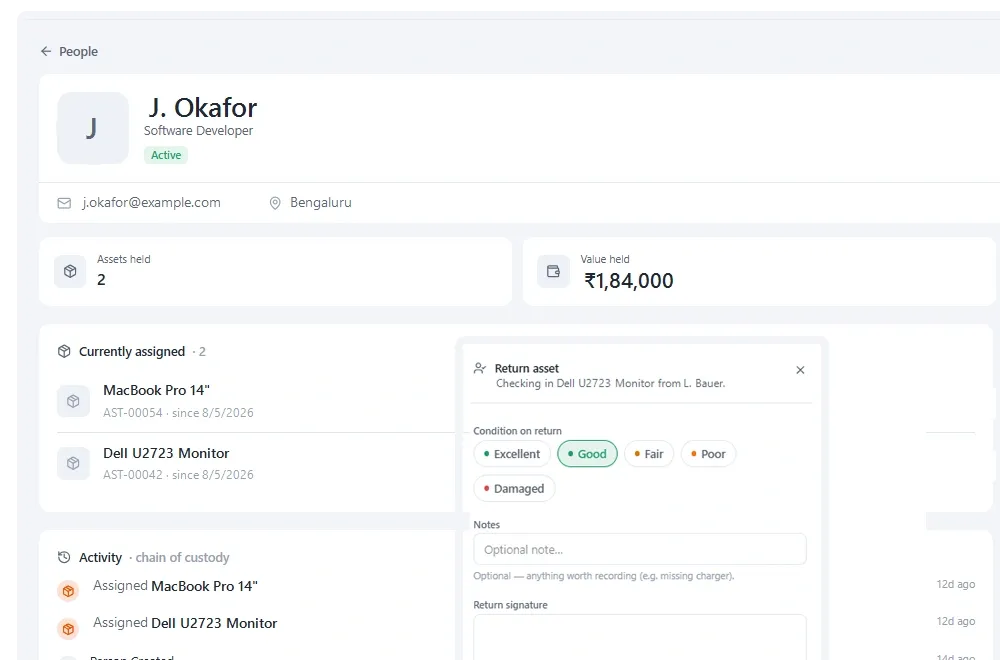
*The departing person's holdings as a list — which turns a delicate conversation into a process.*
Producing the fixed asset count
Firms preparing accounts need a verified count, not an export of what they believe they own. The distinction catches people out every year.
Scoped counts per floor or per office run in an afternoon, close with a signature and a named counter, and produce something finance can file directly. Doing it as one annual sweep across every office is why it gets postponed until it's urgent and then done badly.
One practical note: whoever counts should ideally not be the custodian of what they're counting. It's the first thing a reviewer questions, and in a firm with floors and departments it's usually easy to arrange.
Hot desks and shared equipment
Not everything has a holder, and pretending otherwise makes the register worse.
Meeting room AV, hot-desk monitors and spare equipment live at a location and get counted periodically. Client-facing devices and anything holding data have a named holder and a signature. Deciding which model applies to what — once, deliberately — is most of the work of keeping a firm's register trustworthy.
Key takeaways
- The distinguishing requirement is evidence of who held a device on a past date, not who holds it now.
- A name in a spreadsheet is not a control; a signed chain with dates and condition is.
- Accessory accumulation across a hundred fee earners routinely exceeds the value of the laptop estate.
- Start offboarding recovery at the beginning of the notice period and make it administrative, not a conversation.
- Count per floor or office through the year, with a counter who isn't the custodian.
Frequently asked questions
How do law firms track laptops and confidential devices?
By issuing each device to a named individual with a signature, retaining every holder in sequence rather than overwriting a current-holder field, and closing the custody on return. That combination is what lets you answer who held a specific device on a specific date.
What evidence do we need for a data incident involving a device?
Who held it, from when, that they accepted it, and what controls existed. A signed custody chain with dates provides all four. A register showing a current assignee provides one of them, and not the one that's asked about.
How do we recover equipment from a departing partner or associate?
Generate the list at the start of the notice period and handle it through the same administrative process as access revocation, so it isn't a negotiation. Close with a signed clearance, which also documents that client data left with nothing.
Do we need to track monitors and docks?
Yes. Across a hundred fee earners the accessories usually outvalue the laptops, and they're the items that quietly stay behind when someone leaves because nobody thought to list them.
How long does a floor count take?
Around two hundred items is under an hour of scanning. Reconciling takes longer on a first count, because it surfaces years of accumulated drift, and shrinks considerably on each subsequent one.
Can different departments keep their equipment separate?
Yes, through departments and configurable roles, so each practice group or office manages its own register inside one firm while central functions retain a consolidated view.