

Four facts should decide whether to repair or replace equipment: whether it is still under warranty or contract cover, what it has already cost in repairs, its current depreciated book value, and its failure history. If any answer is “somebody would have to look that up”, the decision is being made without it.
Something comes back broken. Somebody has to decide whether to fix it or bin it, and in most places that call gets made in under a minute, on instinct, by whoever happens to be holding it.
I used to make that call badly for years. Not because I was careless — because the four things that should have decided it were spread across a supplier inbox, a pile of invoices, a finance spreadsheet and my own memory. None of which were in the room.
The framework in one table
|
Factor |
The question |
Where it usually lives |
What it changes |
|---|---|---|---|
|
Cover |
Is it still under warranty, AMC or CMC? |
A filing cabinet or a supplier's inbox |
Whether the repair costs you anything at all |
|
Accumulated cost |
What have we already spent on this unit? |
Scattered across invoices |
Whether this is a repair or an instalment plan |
|
Book value |
What is it worth now, not what it cost? |
Finance, if anywhere |
Whether the repair is proportionate |
|
History |
How has this failed before? |
Nowhere |
Whether the problem is the item or the context |
1. Is it still covered?
The single most expensive thing not to know. Warranty claims are missed for one reason: nobody knew the cover was live at the moment the decision was taken. By the time someone thinks to check, the item has been repaired at your expense or replaced.
This extends well past manufacturer warranty. Extended cover, annual maintenance contracts (AMC) and comprehensive maintenance contracts (CMC) all change the arithmetic, and each has a policy number and a claim route that needs to be to hand rather than in a drawer.
Holding cover on the asset record — with the provider, the policy number, what the cover cost, and who to call — turns this from something a person has to remember into something the system answers at the moment the question is asked.
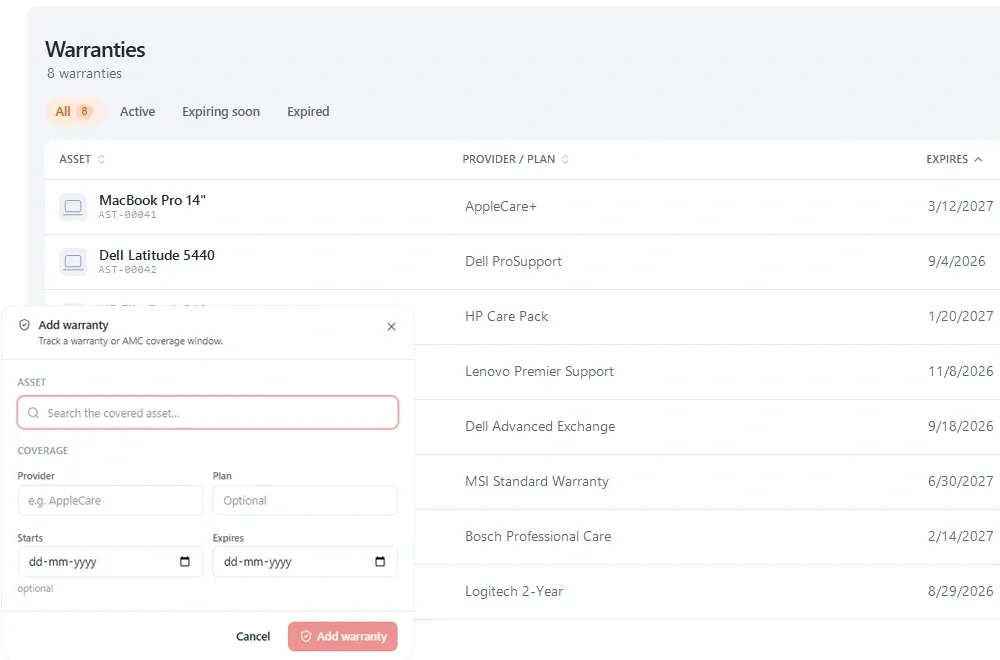
*Cover held against the asset: warranty, AMC and CMC contracts with providers, renewal dates and claim details.*
2. What has it already cost you?
A first repair is a repair. A fourth repair on the same item in eighteen months is a replacement you've been paying for in instalments without noticing, because each individual decision looked reasonable in isolation.
Accumulated repair cost against an asset is the number that exposes that pattern, and it only exists if every ticket recorded what the work actually came to rather than what it was expected to. Estimate is a planning figure; actual is the one that tells you the truth about an item.
A rule of thumb worth adopting: if cumulative repair spend has passed roughly half of replacement cost, stop repairing and put the case for replacement. The exact threshold is yours to set — having the number at all is the point.
3. What is it worth now?
Not what it cost. Current book value — purchase price depreciated over its useful life — is what makes the comparison meaningful.
Spending 60% of replacement cost repairing something with eighteen months of life left is a different decision from spending it on something nearly new, and the two look identical if all you've is the original invoice.
|
Scenario |
Purchase price |
Book value now |
Repair quote |
Sensible call |
|---|---|---|---|---|
|
Nearly new, one-off failure |
£2,400 |
£2,000 |
£600 |
Repair — and claim if covered |
|
Mid-life, third repair |
£2,400 |
£900 |
£600 |
Replace — you are past the halfway point |
|
End of life |
£2,400 |
£200 |
£600 |
Replace — the repair exceeds the asset |
4. What has happened to it before?
The service history, and the custody history alongside it.
An item that has failed the same way three times has a design or handling problem rather than a repair problem. An item that comes back damaged from the same context repeatedly is telling you something about the context — a particular job, a particular vehicle, a particular way it gets packed.
Neither pattern is visible in an individual ticket. Both are obvious in a history, which is why a repair log that lives in email is worth so much less than one that lives on the asset.
The thresholds worth writing down
Judgement is fine until three people are exercising it differently. A written threshold turns a recurring argument into a rule somebody can apply without you.
|
Rule |
Typical setting |
Reasoning |
|---|---|---|
|
Repair ceiling |
Repair quote exceeds 50% of current book value |
Beyond this you are buying an old asset at a new price |
|
Cumulative ceiling |
Lifetime repairs exceed 60% of replacement cost |
You are paying for a replacement in instalments |
|
Recurrence rule |
Third failure of the same type |
It is a design or handling problem, not a repair problem |
|
Age rule |
Past useful life and out of all cover |
Downtime risk usually exceeds the saving |
|
Safety override |
Any safety-critical item that failed |
Replace, regardless of the arithmetic |
Set these once, per category rather than per item, and revisit them annually. The exact percentages matter far less than having them written down.
The failure modes this framework doesn't catch
Two cases where the numbers point one way and the right answer is the other.
The item that keeps stopping work
A cheap item that's repeatedly unavailable can cost far more in delay than its replacement price. The framework values the asset; it doesn't value the work waiting on it. If something has caused three job delays, replace it whatever the book value says.
The last unit of its kind
Sometimes the economic call is to scrap and the operational call is to repair, because it's the only one you've and a replacement is twelve weeks out. Note that reason on the ticket — otherwise the decision looks irrational to whoever reviews the spend later.
Measuring whether your decisions are getting better
- Repeat repair rate — items repaired more than twice in twelve months. Falling means the thresholds are working.
- Claim capture rate — repairs on covered assets that were actually claimed. Should approach 100%; most organisations start well below.
- Estimate versus actual variance — consistently over means your estimates are optimistic, which distorts every decision made on them.
- Average age at replacement — drifting up suggests you are running assets past the point where repairs are sensible.
Making the four facts available at the moment of decision
None of these are hard to capture. Each is a field or a record created in the ordinary course of work: the cover recorded when the asset was acquired, the cost entered when a repair closed, the depreciation method set once, the history accumulating on its own.
What is hard is having all four in the same place when the decision is being made — which is standing next to a broken item, not sitting at a desk with four tabs open.
- Record cover at acquisition, not when you need it. Provider, kind, policy number, claim contact, expiry.
- Close every maintenance ticket with an actual cost, even a rough one. A blank is worth nothing.
- Set a depreciation method on anything above a value threshold you choose, so book value exists without anyone calculating it.
- Keep the repair history on the asset rather than in a mailbox, so patterns are visible rather than remembered.
If your answer to any of the four is “somebody would have to look that up”, the decision is being made without it. Decisions made without them are, on average, expensive in a way that never appears as a line item.
Key takeaways
- Four facts decide it: cover, accumulated repair cost, current book value, and failure history.
- Missed warranty and contract claims are the most expensive single failure, and they happen because nobody checked in time.
- Estimated repair cost is a planning number; only actual cost reveals whether an item is quietly becoming a replacement.
- Compare the repair quote against current book value, not purchase price.
- If any of the four requires looking up, the decision is being made without it.
Frequently asked questions
When should you replace equipment instead of repairing it?
When cumulative repair spend has passed roughly half of replacement cost, when the repair quote exceeds current book value, or when the same failure has recurred. Any one of those is a strong signal; two together usually settle it.
What is the difference between an AMC and a CMC?
An annual maintenance contract typically covers labour and scheduled servicing, with parts charged separately. A comprehensive maintenance contract normally includes parts as well. The distinction changes the repair-or-replace arithmetic considerably, which is why the contract kind belongs on the asset record.
How do you calculate the current book value of equipment?
Apply a depreciation method to the purchase price over the asset's useful life. Straight-line spreads the cost evenly; written-down value applies a fixed percentage to the reducing balance each year. Asset software that stores the method computes the current figure for you.
Why do organisations miss warranty claims?
Because cover expiry is held somewhere other than the asset — a supplier email, a purchase file, somebody's memory — so nobody checks at the moment a repair is authorised. Storing cover on the asset record, with a reminder before expiry, removes the failure mode.
Should repair costs be tracked per asset or per category?
Per asset, and then rolled up by category. Per-category totals tell you where spend goes; only per-asset totals tell you which specific unit is quietly consuming it, which is the decision you actually have to make.