

A preventive maintenance schedule defines what gets serviced, how often, and who is responsible — raised ahead of the due date rather than when something breaks. Start with equipment where failure is expensive or a statutory inspection applies, and keep the list short enough to actually complete.
I've watched a lot of maintenance schedules die, and they nearly all die the same way.
Somebody builds a thorough one. It generates more work than the team can get through. People fall behind. Within two quarters everyone's ignoring it — including the handful of items that genuinely mattered, which are now buried under two hundred that didn't.
A short schedule people finish beats a thorough one they don't. That's the whole argument, and the rest of this is how to decide what stays on it.
What belongs on a schedule
Three tests. An item qualifies if it passes any of them.
|
Test |
Example |
Consequence of skipping |
|---|---|---|
|
Statutory inspection applies |
Lifting gear, harnesses, electrical equipment, pressure systems |
Legal exposure; equipment barred from use; a stopped job |
|
Failure is expensive or dangerous |
Generators, plant, critical instruments |
Unplanned downtime, or a safety incident |
|
Calibration affects output validity |
Test equipment, measuring instruments, lab devices |
Work done on bad readings, discovered at audit |
Equipment that fails cheaply, predictably and without consequence doesn't need a schedule. Fix it when it breaks and spend the attention elsewhere.
Setting intervals that hold
Start from the obligation or the manufacturer, then adjust with evidence.
- Statutory intervals are not yours to choose. Take them from the regulation and treat them as fixed.
- Manufacturer intervals are a starting point, usually conservative, written for the heaviest expected duty.
- Usage matters more than calendar time for anything that runs. An item used daily and one used monthly should not share an interval.
- Adjust on evidence, in one direction at a time. If three consecutive services find nothing, consider lengthening. If failures occur between services, shorten.
Raise the work before the date, not on it
A schedule that surfaces work on the day it's due has already failed, because parts need ordering, engineers need booking, and the item needs taking out of service without wrecking somebody's week.
Raising the ticket ahead of the due date turns maintenance from an interruption into something plannable. How far ahead depends on the lead time for the work — a week for an internal check, considerably longer for a specialist visit.
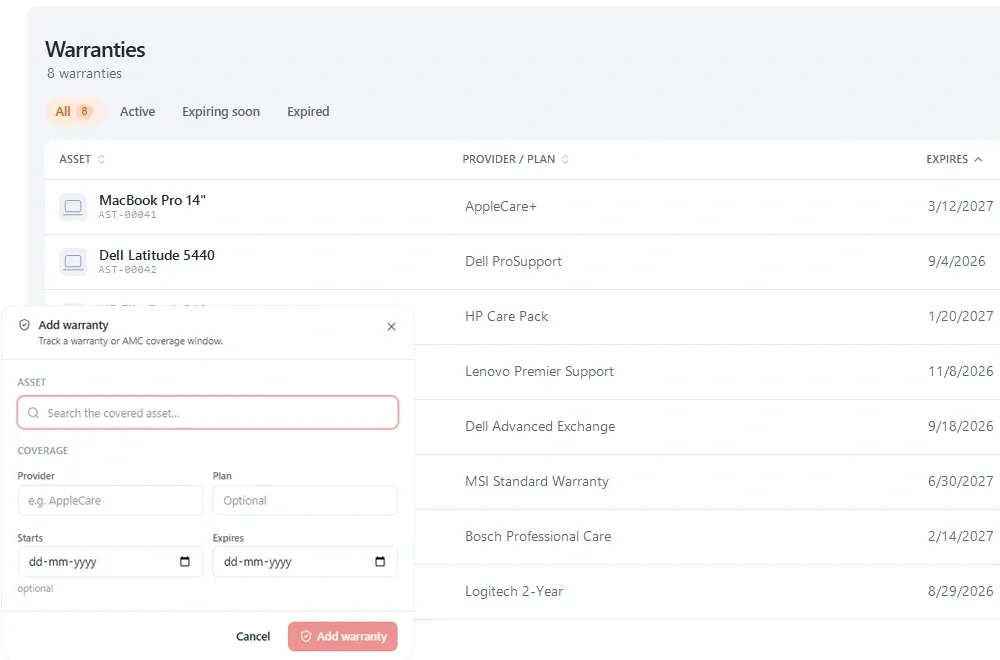
*Servicing and cover held against the asset, with renewals and inspections warned ahead of the date rather than on it.*
Statutory inspections deserve separate handling
Servicing is an efficiency. Statutory inspection is a legal duty with an evidence requirement, and the consequence of a lapse isn't a broken tool but a stopped job, a failed audit or worse.
Three things make the difference:
- The reminder fires early enough to arrange a specialist, not on the expiry date.
- The result is recorded against the asset, not filed separately, so the evidence is where the equipment is.
- Out-of-certification equipment cannot be issued. A system that will happily hand out an uncertified harness has automated the wrong thing.
Who does the work, and who chases it
Schedules decay when ownership is ambiguous. Each scheduled item needs a named owner — the person who does it or arranges it — and an escalation when it's overdue.
In smaller organisations this is one person for everything, which is fine as long as it's written down. The failure mode is assuming that because everyone can see the schedule, someone is watching it.
Getting intervals right without guessing
Manufacturer intervals are written for the heaviest expected duty, which means they're conservative for most users and occasionally optimistic for heavy ones. Adjust on evidence, and only in one direction at a time.
|
Evidence |
Action |
Caution |
|---|---|---|
|
Three consecutive services find nothing |
Consider lengthening by 25% |
Never for statutory intervals |
|
Failure occurred between services |
Shorten by 25% and review after three cycles |
Check it was not misuse first |
|
Usage far below assumption |
Switch to usage-based if you can measure it |
Calendar-based degradation still applies to some parts |
|
Usage far above assumption |
Shorten, and consider a second unit |
Servicing may not be the real constraint |
Record why an interval changed, on the plan. In two years nobody will remember, and an unexplained interval gets reverted by whoever inherits it.
Who actually does the work
Schedules decay when ownership is ambiguous, and ambiguity is the default state. Each scheduled item needs a named owner and an escalation when it goes overdue.
In a small organisation that's one person for everything, which is fine as long as it's written down. The failure is assuming that because the schedule is visible to everyone, somebody is watching it. Visible isn't the same as owned.
Keeping equipment out of service while work is open
The control that matters most and gets implemented least.
An item with an open maintenance ticket, or one past a statutory inspection date, shouldn't be issuable or bookable. Not flagged — blocked. A warning that can be clicked through is a warning that will be clicked through at seven in the morning when a team is waiting.
It also solves the argument about whether servicing is worth the disruption, because the disruption becomes visible in the booking calendar rather than arriving as a surprise on the day.
Measuring whether it's working
|
Metric |
What it tells you |
Target direction |
|---|---|---|
|
Schedule completion rate |
Share of scheduled work done within its window |
Above 90%, and stable |
|
Overdue inspections |
Statutory work past its date |
Zero, always |
|
Unplanned repairs on scheduled assets |
Whether the schedule is preventing anything |
Falling |
|
Repeat failures |
Items failing the same way despite servicing |
Investigate individually — the schedule is not the problem |
If completion rate is below about 70%, the schedule is too large rather than the team too slow. Cut it back to the items that pass the three tests and rebuild from there.
Key takeaways
- Include equipment only where a statutory inspection applies, failure is expensive, or calibration affects validity.
- Take statutory intervals from the regulation; treat manufacturer intervals as a starting point and adjust on evidence.
- Raise work ahead of the due date by the lead time the work needs, so it can be planned.
- Block out-of-certification equipment from being issued rather than relying on someone noticing.
- A completion rate below about 70% means the schedule is too big, not the team too slow.
Frequently asked questions
What is a preventive maintenance schedule?
A defined plan of what equipment gets serviced or inspected, at what interval, and by whom — with the work raised ahead of its due date rather than triggered by a failure. It covers both manufacturer-recommended servicing and statutory inspection regimes.
How often should equipment be serviced?
Statutory intervals are set by regulation and aren't adjustable. For everything else, start from the manufacturer's recommendation, weight it by actual usage rather than calendar time, and adjust on evidence — lengthen after several clean services, shorten if failures occur between them.
What is the difference between preventive maintenance and a statutory inspection?
Preventive maintenance is work you choose to do to avoid failure. A statutory inspection is a legal duty with a required record, and the consequence of missing it's regulatory rather than operational. They often coincide on the same asset but should be tracked distinctly.
Why do preventive maintenance schedules fail?
Almost always because they're too large. A comprehensive schedule generates more work than the team can complete, everyone falls behind, and the schedule stops being trusted — including the parts that genuinely mattered. Start small and expand only what proves its worth.
Should equipment be unavailable while maintenance is open?
Yes for anything safety-related or out of certification. An asset with an open maintenance ticket should leave the bookable pool automatically, so nobody reserves or issues something that's on a bench or out of date.