

A manufacturer warranty covers defects for a fixed period at no cost. An AMC is a paid contract covering scheduled servicing and labour, usually excluding parts. A CMC is the same but normally includes parts. Which you hold changes who pays when equipment fails — and most organisations cannot say which they hold.
A customer rang me last month about a £1,900 repair bill. The equipment was under contract. The contract didn't cover parts, and the failure was a part. Nobody had read the terms since signing, because nobody had needed to until that morning.
Warranty, AMC and CMC get used interchangeably in conversation all the time. They aren't interchangeable, and the difference turns up on an invoice at the worst possible moment.
The three, side by side
|
|
Manufacturer warranty |
AMC |
CMC |
|---|---|---|---|
|
What it is |
Defect cover included with purchase |
Annual maintenance contract |
Comprehensive maintenance contract |
|
Paid for separately |
No |
Yes |
Yes |
|
Scheduled servicing |
Usually not |
Yes |
Yes |
|
Labour on repairs |
Yes, for defects |
Usually yes |
Yes |
|
Spare parts |
Yes, for defects |
Usually charged extra |
Normally included |
|
Accidental damage |
No |
Usually not |
Sometimes, check terms |
|
Typical duration |
1–3 years from purchase |
12 months, renewable |
12 months, renewable |
|
Ends when |
Period expires |
You stop renewing |
You stop renewing |
The single most consequential row is spare parts. An AMC that excludes parts on equipment whose failures are mostly component failures may cover very little of what you actually spend.
Warranty: what it does and doesn't do
A manufacturer warranty covers defects — the item was faulty, or failed in a way it shouldn't have within the period. It's included in the purchase price and it expires on a date.
It doesn't cover wear, misuse, accidental damage, or scheduled servicing. It also doesn't usually survive a repair by an unauthorised party, which is a common and expensive way to void cover without realising.
The practical failure with warranty is never the terms. It's that nobody knows the item is still inside the period at the moment a repair is authorised.
AMC: what you're buying
An annual maintenance contract is a paid agreement, usually renewed yearly, under which a provider services the equipment on a schedule and attends failures. Labour is generally included; parts are generally not.
AMCs make sense for equipment where scheduled servicing genuinely prevents failure, where downtime is expensive, or where a statutory inspection regime exists and you would rather a specialist owned it.
They make less sense for equipment that rarely fails, or where parts cost dominates and is excluded anyway.
CMC: the same, with parts
A comprehensive maintenance contract covers what an AMC covers plus spare parts. It costs more and shifts the risk of an expensive component failure onto the provider.
The decision between AMC and CMC is a straightforward expected-cost calculation: if the parts you expect to replace over a year cost more than the price difference, the CMC is cheaper. The difficulty is that most organisations can't answer what they spent on parts last year, per asset — which is itself an argument for recording actual repair costs against assets.
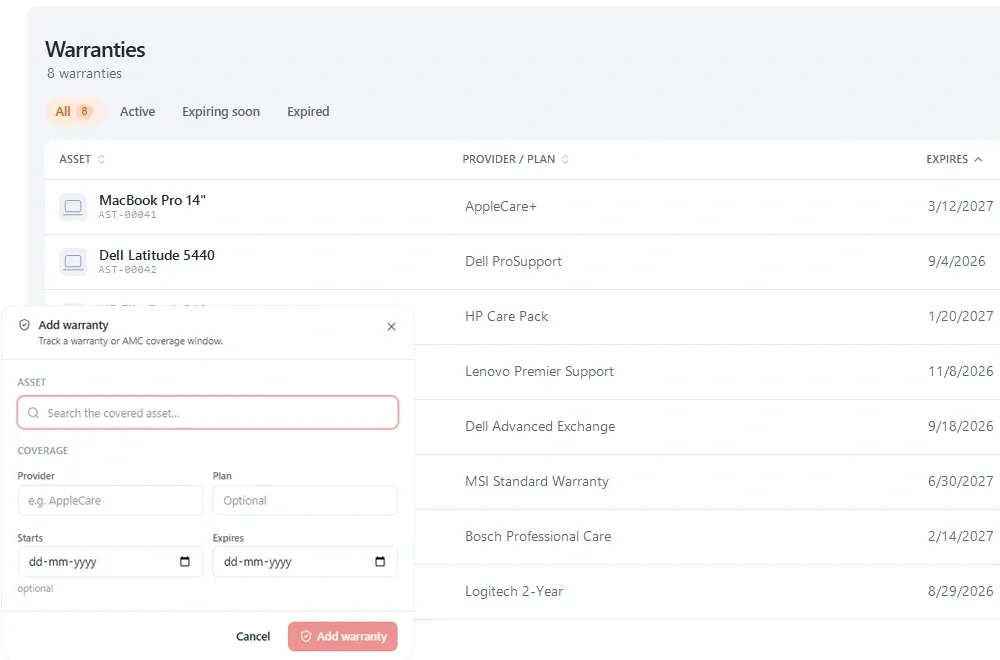
*Cover recorded per asset with its kind, provider, policy number and renewal date — so the question 'what are we covered for' has an answer.*
Where they overlap, and where you pay twice
Buying an AMC on equipment still inside its manufacturer warranty is common and often wasteful. For the overlapping period you may be paying for labour you would have received free.
It isn't always wrong — an AMC usually adds scheduled servicing that the warranty doesn't include, and that may be the thing you actually want. But it should be a decision rather than an accident, and it can only be a decision if warranty expiry is recorded somewhere visible.
What to record against every covered asset
- Kind — manufacturer, extended, AMC or CMC. Without this, none of the other fields mean anything.
- Provider, and the vendor record behind them, so spend by provider is a report rather than an archaeology exercise.
- Policy or contract number — the thing you are asked for first on any claim call.
- Claim contact — a phone number, email or portal. Finding this is where claim time goes.
- Cost of cover, so total cost of ownership includes what you paid to be protected.
- Start and expiry dates, with a reminder before expiry rather than after.
- Terms — what is and is not covered, in the provider's words, for the argument later.
Deciding between AMC and CMC, with numbers
This is an expected-cost calculation and it's simpler than it looks — the hard part is having the data, which is itself an argument for recording actual repair costs against assets.
- Take last year's parts spend on the equipment in question. Parts only, not labour.
- Take the price difference between the AMC and CMC quotes.
- If parts spend exceeded the difference, the CMC would have been cheaper. If not, the AMC was.
- Then adjust for variance: if a single component failure could exceed the difference several times over, the CMC is also buying you predictability, which has value beyond the average.
|
Scenario |
Parts spend last year |
CMC premium |
Sensible choice |
|---|---|---|---|
|
Stable, low-failure equipment |
£400 |
£1,200 |
AMC — you are paying for cover you do not use |
|
Ageing equipment, rising failures |
£2,100 |
£1,200 |
CMC, clearly |
|
New equipment, one expensive component |
£0 |
£1,200 |
Depends on risk appetite — the failure would be £6k |
Reading the exclusions, briefly
Nobody reads these until a claim is refused. Four exclusions cause most of the refusals:
- Consumables and wear parts — belts, filters, batteries. Frequently excluded even under a comprehensive contract.
- Accidental damage and misuse — almost always excluded, and 'misuse' is defined by the provider.
- Unauthorised repair — opening the item yourself commonly voids everything, including future claims.
- Response times — often a target rather than a commitment, unless the contract says otherwise explicitly.
Record the exclusions on the asset alongside the policy number. The moment you need them is the moment nobody can find the contract.
Renewals are where cover quietly lapses
Annual contracts expire annually, which sounds obvious and is routinely missed. The failure is usually organisational: the person who arranged the contract has moved on, the renewal notice went to an inbox nobody reads, and the lapse is discovered when a claim is refused.
Two things prevent it. A reminder that fires before expiry rather than on it, and a renewal chain on the record so a renewed contract keeps the history of the one it replaced — which is what lets you see that cover has been continuous rather than assuming it.
Key takeaways
- Warranty covers defects and is included; AMC and CMC are paid contracts you renew.
- The decisive difference between AMC and CMC is whether spare parts are included.
- Buying an AMC during the manufacturer warranty period often duplicates labour cover — make it a decision, not an accident.
- Record kind, provider, policy number, claim contact, cost, dates and terms against the asset itself.
- Annual contracts lapse annually; a reminder before expiry and a renewal chain prevent silent gaps.
Frequently asked questions
What is the difference between AMC and CMC?
An annual maintenance contract generally covers scheduled servicing and labour but charges for spare parts. A comprehensive maintenance contract normally includes parts as well. Everything else is usually similar, so the parts question is what the price difference buys.
Is an AMC worth it if equipment is under warranty?
Sometimes, but check what you're duplicating. A warranty covers defects and usually not scheduled servicing, so an AMC may add real value — or it may pay for labour you would have received free. It should be a deliberate choice, which requires knowing the warranty expiry.
What should an AMC contract include?
The scope of servicing and its frequency, response times for failures, whether parts are included or charged, what's excluded, the contract period and renewal terms, and the escalation route. Record the policy number and claim contact somewhere your team can find them under pressure.
How do you track equipment warranty and contract expiry?
Hold cover on the asset record with its kind, provider, policy number and expiry date, and set a reminder that fires ahead of the date. Tracking expiry in a spreadsheet works until the person who maintains it moves on, which is when most lapses happen.
Does repairing equipment yourself void the warranty?
Often, yes — many manufacturer warranties are void if an unauthorised party opens or repairs the item. Check the terms before authorising an in-house repair on anything still in warranty, which is another reason the cover status needs to be visible at the moment of the decision.