

Growing teams don't lose track of equipment because anyone is careless. They lose track because the process that worked at thirty people assumed one person could hold it in their head, and at a hundred and twenty nobody can. The fix is making the record a by-product of onboarding and offboarding rather than a separate task.
The moment I remember most clearly was a Monday when three new starters arrived and we had two laptops ready.
Not because we hadn't bought enough. We'd bought plenty. Two were sitting in a drawer in the other office, one had gone home with someone who left in March, and nobody could tell me which of the four spares in the cupboard actually worked.
That's what growth does to equipment management. Nothing dramatic breaks. The informal system just quietly stops scaling, and you find out on the worst possible morning.
What actually changes as you grow
|
Headcount |
What breaks |
What to put in place |
|---|---|---|
|
Under 30 |
Nothing — one person knows where everything is |
A list. Genuinely, that's enough |
|
30–80 |
That person goes on holiday |
Named holder per item, more than one recorder |
|
80–150 |
Reassignment loses history; leavers keep things |
Signed handovers, generated offboarding lists |
|
150+ |
Finance asks for book value and nobody has it |
Depreciation basis at acquisition, scoped counts |
The pattern worth noticing is that each row is a response to a failure that already happened. Nobody puts signed handovers in place preemptively — they put them in after the first awkward conversation about a laptop that didn't come back.
Onboarding: one action, not five
A new starter gets a laptop, a dock, a monitor, a keyboard, a mouse and a headset. Six items, and in most organisations somewhere between one and zero of them get recorded.
The laptop gets recorded because it's expensive and obviously company property. The rest don't, and the rest are what never come back — which is a genuinely annoying thing to discover, because collectively they often cost more than the machine.
- Issue the whole kit in one action against one name, so recording six items costs the same as recording one.
- List the accessories explicitly. A line saying 'laptop and peripherals' recovers a laptop.
- Capture a signature on the device at handover. Fifteen seconds, and it's the moment the person registers that this is theirs to look after.
- Send them the list. People who have a list treat the contents differently from people who don't.
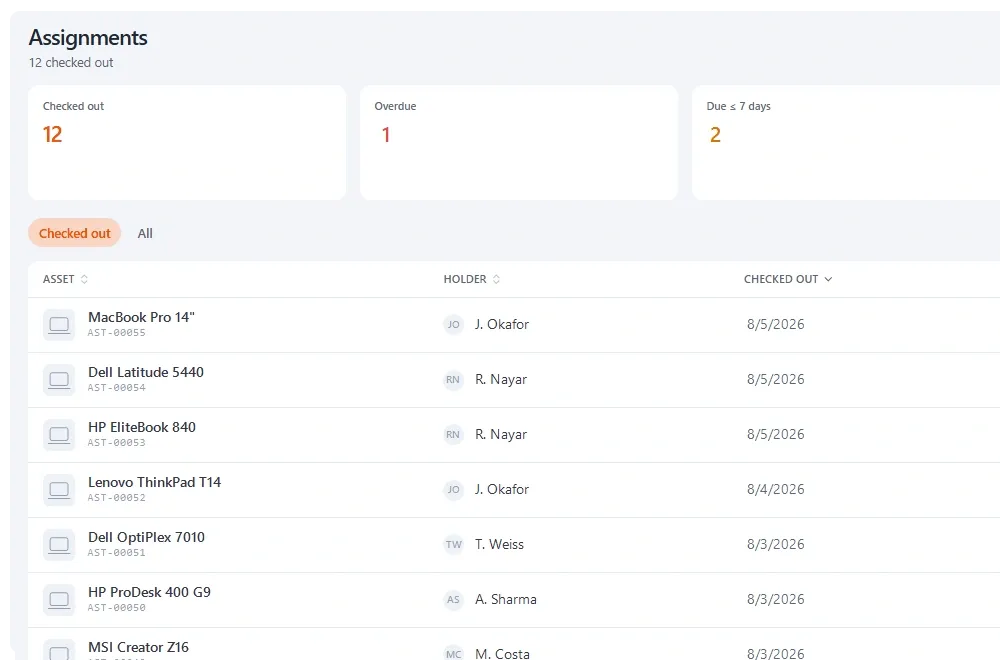
*The whole kit issued against one name, signed for at the point of handover.*
Reassignment, and why it quietly destroys history
A laptop comes back from a leaver, gets wiped, and goes out to a new starter. The common mistake is treating that as a new asset — new record, new number, fresh start.
You've just thrown away the purchase date, the warranty expiry, the two repairs it's already had, and the fact that it's on its third battery. All of which you'd want when it fails again in eight months and someone asks whether to fix it.
It's a transfer. One asset, one continuous history, a new holder. That distinction costs nothing at the time and is worth a lot later.
Offboarding is where the money is
If you do one thing from this article, do this one.
Departures are the single most concentrated source of unrecovered equipment in a growing company, and it's almost never deliberate. Somebody resigns, works a month, hands back the laptop because that's the obvious thing, and keeps two chargers, a dock and a monitor that nobody mentioned because nobody had the list.
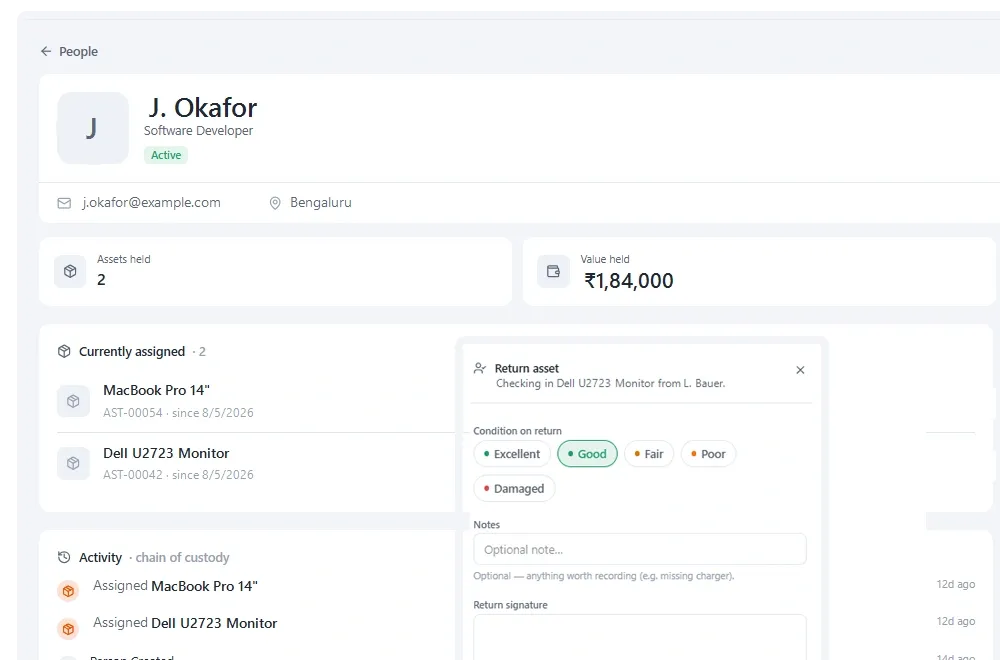
*What the leaver holds, generated from their record rather than reconstructed by asking their manager.*
- Generate the list from their record. Not an email to their manager asking what they think the person has.
- Check each item in with a condition note, rather than closing the whole custody in bulk.
- Record what's outstanding while they're still contactable, which is a window measured in days.
- Wire it into the leaver process so HR pulls the list automatically rather than remembering to ask IT.
The spares cupboard problem
Every growing company develops a cupboard. It contains equipment that came back, equipment nobody claimed, equipment that might be broken, and equipment that definitely is.
Nobody audits it because nothing in it is assigned to anyone, so it's nobody's problem — and meanwhile you're buying new laptops.
|
State |
What to do |
Why it matters |
|---|---|---|
|
Working, unassigned |
Location = spares, status = available |
This is stock you already own |
|
Awaiting wipe |
Status reflects it |
Stops it being issued with old data on it |
|
Faulty, unrepaired |
Open maintenance ticket |
Stops it being issued at all |
|
Beyond economic repair |
Dispose and close the record |
Otherwise it inflates every count forever |
Half an hour applying that to your cupboard usually finds several usable machines, which is a faster way to solve a laptop shortage than a purchase order.
When finance starts asking
This arrives with a funding round, a first audit, or a new finance lead, and the request is always the same: what do we own, what's it worth, and can you prove it.
Purchase price isn't the answer — they want depreciated book value. Setting a depreciation method at acquisition, by category rather than per item, means the figure exists when asked for instead of being reconstructed from three years of invoices over a fortnight.
And 'prove it' means a count somebody physically carried out on a date, not an export of what you believe you own. Those are different documents and only one of them satisfies an auditor.
Key takeaways
- Growth breaks equipment tracking by outgrowing one person's memory, not through carelessness.
- Issue a starter's whole kit in one action and list accessories explicitly — they're what never comes back.
- Reassignment is a transfer, not a new asset; a new record throws away warranty and repair history.
- Offboarding is the highest-value fix available: generate the list rather than asking a manager.
- Set a depreciation basis at acquisition so book value exists before finance asks for it.
Frequently asked questions
How do you track IT equipment in a fast-growing company?
Record custody at the moment of handover rather than afterwards, issue whole kits in one action, treat reassignment as a transfer so history survives, and generate the offboarding list from the person's record. The common thread is that the record is a by-product of something you were doing anyway.
What equipment should we track for each employee?
Everything you issued, including the accessories. Laptop, dock, monitors, keyboard, mouse, headset, phone, and any peripherals. The accessories feel too cheap to bother with, which is precisely why they don't come back.
When should a growing company move off a spreadsheet?
Usually somewhere between thirty and eighty people — the point where more than one person needs to update it and the original owner is no longer a reliable single source. Waiting past that means a migration with accumulated drift baked into it.
How do we stop leavers keeping equipment?
Produce the list from their record and work it as a checklist before their last day. Most non-returns are forgetfulness rather than intent, and the list solves forgetfulness. Send it with the signed agreement if there is one.
Should we track monitors and docks or just laptops?
Track them. At five accessories per person they outnumber the laptops several times over and cost more in aggregate, and they're the items nobody thinks to ask for back.
How often should we count?
Scoped counts per floor or per department through the year rather than one annual sweep. The coverage is the same and discrepancies surface while somebody still remembers what happened.