

Asset management software is usually priced per asset, per user, or as a flat team plan, with open-source options free to licence and expensive to run. The model matters more than the headline figure, because per-asset pricing quietly discourages complete registers and per-user pricing limits who can keep them accurate.
I get asked for a number, and the honest answer is that the number isn't the interesting part.
What actually determines your cost — and, more importantly, what you end up with — is the pricing model. Two tools at identical list prices will produce completely different registers depending on how they charge, because the model quietly shapes what you decide to track and who you let near it.
The four models
|
Model |
How it scales |
Typical range |
What it does to your register |
|---|---|---|---|
|
Per asset / item tier |
Bill rises as you register more |
Tiers from a few hundred to tens of thousands of items |
You stop registering cheap items to stay inside a tier |
|
Per user / seat |
Bill rises with people who can access it |
Roughly £10–£40 per user per month |
You ration operators, so records get made second-hand |
|
Flat team plan |
Rises with capability, not usage |
Roughly £30–£250 per month per organisation |
No structural pressure either way; check plan limits |
|
Open source, self-hosted |
Free licence, paid infrastructure and staff time |
£0 licence, real operational cost |
Cheap until you count the person maintaining it |
Those ranges are indicative and move constantly, which is exactly why I'd rather talk about the model. A vendor's price page is accurate today; the incentive it creates lasts for years.
What per-asset pricing actually costs you
This is the one I'd push back on hardest, and not because we don't use it.
When the bill rises with your item count, every decision to register something carries a cost. Predictably, the things that get left off are the cheap, numerous, portable ones — adaptors, testers, hand tools, chargers. And those are precisely the items that go missing quietly.
Every team I've spoken to on an item-count plan had made at least one deliberate decision not to register something in order to stay inside a tier. That's a hole in your controls, and it's always in the same place.
What per-user pricing actually costs you
Same shape, different consequence. Charge for operators and organisations ration operators.
The result is one person who does all the issuing, which works fine until they're on leave, and a register where most entries were made afterwards by somebody who wasn't there. Data quality falls in exact proportion to how many of the people handling equipment can't record it.
The costs nobody puts in the business case
- Labels. Pennies each on standard stock, considerably more for weatherproof or industrial. Budget for reprints — labels come off.
- Implementation. Enterprise platforms often come with it and price it separately. Self-serve tools usually don't need it.
- Data migration. Usually an afternoon if you have a clean export. Longer if you're merging three spreadsheets that disagree.
- Staff time to configure. The real cost of highly configurable platforms, and the one that sinks them when nobody owns it.
- Hardware. Only if you're going down the dedicated-scanner or RFID route. Phone cameras are free and already deployed.
- The person running it, if you self-host. Backups, upgrades, the database. Not free, however the licence is priced.
A sensible way to compare
- Write down your actual asset count, your actual number of people who touch equipment, and your expected growth in both over three years.
- Run each shortlisted tool's pricing against all three years, not just year one.
- Add the hidden costs above to each.
- Then — and this is the bit people skip — ask what each model would make you stop doing. If the answer is 'register fewer items' or 'let fewer people record things', price that in as a risk, not a saving.
What the price should include, and usually doesn't
Two vendors quoting similar monthly figures can differ enormously once you read what's in the plan. The rows worth checking before you compare anything:
|
Item |
Question to ask |
Why it bites |
|---|---|---|
|
Users |
Is there a per-seat charge, and are 'viewers' counted? |
Decides who can keep the register accurate |
|
Assets |
What's the limit, and what happens at it? |
Some tools stop writes; others upsell mid-month |
|
API access |
Which tier, and is there a call limit? |
Often gated two tiers above where you'd expect |
|
Support |
Email only, or is there a human? |
Matters most during migration, which is when you need it |
|
Data export |
Full export, in what formats, on which tier? |
Export gated behind a tier is a lock-in mechanism |
|
Sandbox |
Can you trial with real data? |
A demo environment tells you almost nothing |
The export row is the one I'd push hardest on. A tool that makes leaving expensive has told you something about how it intends to keep you.
Three-year totals, because year one lies
Every pricing model looks reasonable in year one. The differences compound.
Take your actual numbers — asset count, headcount touching equipment, and honest growth for both — and run each shortlisted tool across three years. A per-asset model that's cheapest today is frequently the most expensive by year three, and a per-user model does the same to an organisation that's hiring.
Then add the one-off costs: labels, migration, configuration time, any hardware. Spread those across the three years and compare totals, not monthly figures.
Negotiating, briefly
- Annual beats monthly almost everywhere — commonly 10–20%.
- Ask what happens at the tier boundary before you sign, not when you hit it.
- Get migration help written in if you're moving a real estate. It's often given freely and rarely offered unprompted.
- Ask for the price at renewal, not just at signing. Introductory pricing that doubles in year two is common and rarely volunteered.
Is free good enough?
Sometimes, genuinely. AssetTiger has a generous free register. Snipe-IT is free if you can self-host. Our own free tier includes unlimited users because we'd rather you tried it properly than evaluated a demo.
Free tiers stop being enough at a fairly predictable point: when you need signed custody, when two teams start needing the same item on the same day, or when somebody external asks for a verified count. Until then, paying for software you don't need is just a slower way to have the same spreadsheet.
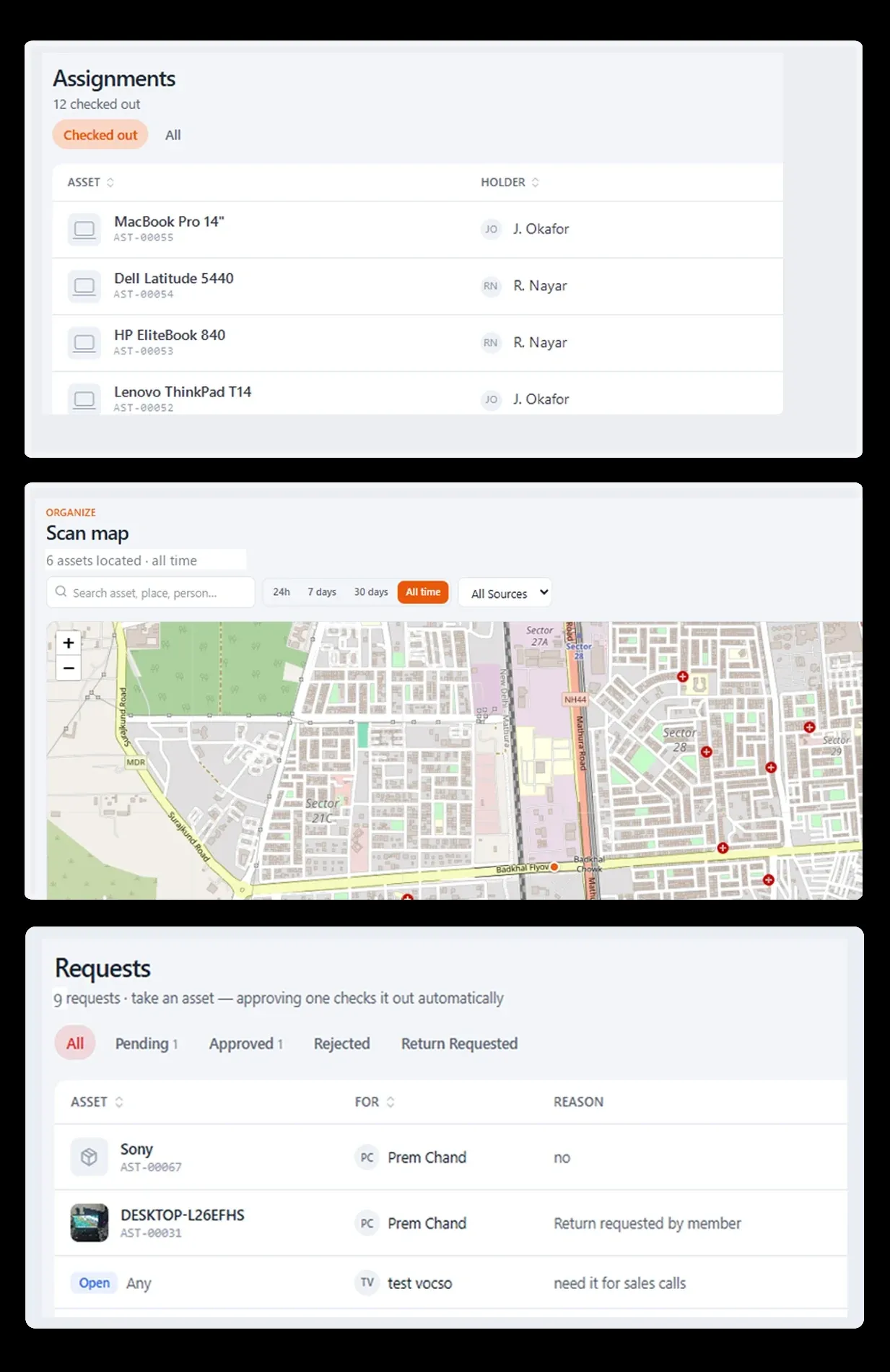
*What you're buying, in the end, is the ability to answer questions like these without going and looking.*
Key takeaways
- The pricing model matters more than the list price, because it shapes what you register and who can record it.
- Per-asset tiers push you to leave cheap portable equipment off the books — exactly where losses happen.
- Per-user pricing rations operators, so records get created second-hand by people who weren't present.
- Budget for labels, migration, configuration time, and — if self-hosting — the person who maintains it.
- Compare over three years against your real asset and headcount growth, not year one.
Frequently asked questions
How much does asset management software cost per year?
It depends far more on the pricing model than on the vendor. Flat team plans commonly land between a few hundred and a few thousand pounds a year for a mid-sized organisation. Per-user and per-asset models can be cheaper or considerably more depending on your shape — run your own numbers over three years.
Is there free asset management software?
Yes. AssetTiger offers a generous free register, Snipe-IT is free and open source if you can self-host, and several commercial tools including ours have a free tier. Free usually stops being enough when you need signed custody, bookings or verified audits.
Why is per-asset pricing a problem?
Because it makes registering an item a cost decision. The predictable result is that cheap, numerous, portable equipment gets left off to stay inside a tier — and that's exactly the equipment that disappears. You end up paying for a register with a hole in the most important place.
What hidden costs should I budget for?
Labels and reprints, data migration, staff time to configure, implementation fees on enterprise platforms, any scanning hardware, and — if you self-host — the infrastructure and the person maintaining it. The last one routinely dwarfs the licence saving.
Should we pay per user or per asset?
Depends on your shape. A large team with a small register does better on per-asset; a small team with a large register does better on per-user. A flat team plan avoids both distortions. Work out which of the two you'd feel, then compare within that shape.