

Most company equipment isn't stolen. It's mislaid through undocumented handovers, left behind at sites, taken by leavers nobody produced a list for, or never registered at all. Each is a documentation failure at an identifiable moment, and each has a specific fix.
Ask an ops manager where the kit goes and you'll get some version of "people walk off with it".
Then ask for an actual example. The story is never theft. It's that somebody lent a spare laptop to another team, who passed it on again, and by Thursday nobody could tell you who had it. Everyone involved acted in good faith. The tool's still gone.
Worth being clear about this, because security measures do nothing at all about that story.
Where it actually goes
|
Cause |
What happens |
Where the chain broke |
|---|---|---|
|
Informal lending |
Lent to another team, then passed on again |
The first handover nobody wrote down |
|
Left behind |
In a van, at a venue, on site, in a case that came back empty |
No check-in at the point of leaving |
|
Leavers |
Somebody goes and nobody asks for the kit back |
No list of what they held |
|
Never registered |
It wasn't on the books to start with |
Registration — usually a deliberate exclusion |
That last row is the big one, and it turns up in nobody's figures, because you can't lose what was never recorded. It's the cheap, numerous, portable stuff that got left off to keep the register manageable. Or, more often than people admit, to stay inside a pricing tier that charges by the item.
Why having a register doesn't stop it
Most systems hold a current holder. That field gets overwritten every time the thing changes hands. So it stores one fact — the most recent one — and destroys everything before it.
Fine for "where should this be right now". No use whatsoever for "who had it in March", which is the question you actually get asked, always after the event.
|
Question |
Current-holder field |
Chain of custody |
|---|---|---|
|
Who has it now |
Yes |
Yes |
|
Who had it in March |
No |
Yes |
|
When it changed hands |
No |
Yes |
|
That they accepted it |
No |
Yes, with a signature |
|
Condition at each handover |
No |
Yes |
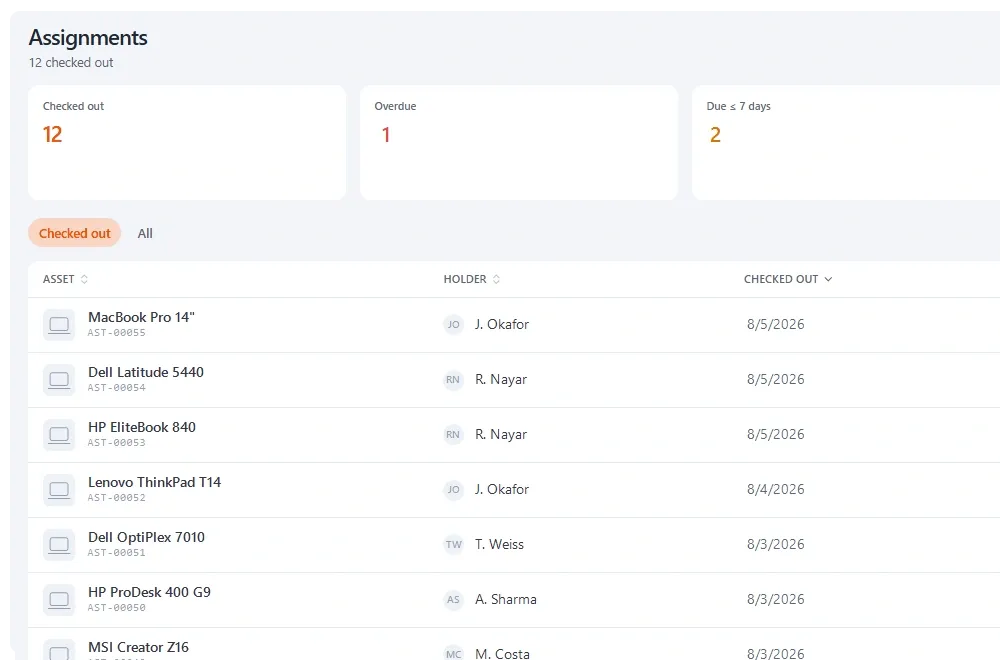
*Every item against a name and a date, with overdue surfaced rather than discovered.*
The signature bit, which sounds like bureaucracy and isn't
A database entry is an administrative fact the person it concerns may never lay eyes on. A signature is fifteen seconds in which somebody knowingly takes on responsibility for something expensive.
People treat kit they've signed for differently. That's the mechanism. The record you end up with is a useful by-product, not the point.
The handover that breaks every chain
Kit doesn't go back to the store between users. It goes from one bloke to another in a car park at seven in the morning.
Most systems model that as a check-in followed by a check-out. Which means either the register is wrong until somebody does the paperwork, or — and this is what actually happens — nobody does two transactions standing in the rain and the paperwork never exists.
Being able to record a straight person-to-person transfer in one action isn't a convenience. It's the difference between a chain of custody and a chain with the holes in exactly the places things disappear.
Six things that work, roughly in order
- Register the cheap stuff. The tail you left off is where the quiet losses live, and collectively it's usually bigger than the expensive items everyone frets about.
- Give everything a named holder — a person, not a department. You can ask a person. You can't ask a warehouse.
- Get a signature at handover, at least on the categories that matter. Fifteen seconds, and it turns a record into evidence.
- Make offboarding a checklist generated from the person's record, not an investigation run during the week there's least time for one.
- Support direct transfers as a single action, because that's how kit genuinely moves.
- Check kit back in on site, at the end of the job, rather than at the yard the next morning.
That last one costs nothing and works better than almost anything else on the list. A missing item at pack-down is usually still findable — it's in a case, on the truck, behind a curtain. The same item missing next morning has gone.
Putting a number on it, so somebody will act
"We lose a lot of kit" doesn't get budget. A figure does, and you can produce one in an afternoon without any software at all.
- Pick one location or category. Not the whole estate — you want an answer this week, not a project.
- Pull the expected list from whatever record you have.
- Go and physically check it. Tick, or don't.
- Count the discrepancies and multiply by replacement cost.
That's your loss rate for that scope, measured rather than estimated, and it's considerably harder to argue with than anything I could tell you. It also gives you a baseline to measure against later, which matters more than the headline number.
Two cautions. Your first count will find a pile of items that were disposed of and never closed out — those aren't losses, and counting them as such wrecks your credibility. And a single count is a snapshot; the trend across three of them is the useful thing.
The insurance conversation, which is where this usually bites
Most policies covering business equipment expect you to have exercised reasonable control. What that means in practice varies, but assessors consistently ask three questions:
- Can you identify the item — serial, description, purchase evidence?
- Can you show who held it and when?
- Was there a process, or did this item simply go unaccounted for?
A register answers the first. Only a custody trail answers the second and third. I'd rather find that out before a claim than during one, and organisations usually find out during one.
The order I'd actually do this in
|
Step |
Effort |
What it addresses |
When you'd skip it |
|---|---|---|---|
|
Register the excluded tail |
A day |
The largest invisible loss category |
If nothing was excluded |
|
Named holder on everything portable |
A day of asking |
'I think Dan has it' |
Never — this is the one |
|
Signatures on high-value categories |
Setup, then 15s per handover |
Disputes, leaver recovery |
Low-value shared items |
|
Offboarding list wired into HR's process |
An hour |
The most concentrated loss event |
Never |
|
Direct transfers enabled |
Configuration |
Chain breaks at the handover |
Static equipment only |
|
On-site check-in at end of job |
A habit, not a cost |
Items still findable |
Office-only equipment |
Six things. Four of them cost nothing but attention, and between them they address every cause in the table at the top of this article.
Things that sound sensible and aren't
GPS tags on everything
Per tag, per month, plus batteries to manage. And they answer "where is it", not "whose problem is it". For kit that moves between people rather than wandering off by itself, custody is the more useful signal and a fraction of the cost. Keep GPS for a handful of genuinely high-value items where location really is the question.
Tightening the rules without reducing the effort
A rule that makes the right thing slower gets routed around. If signing something out takes longer than not bothering, people won't bother — and now you've lost the record as well as the control.
Blaming whoever had it last
Losses cluster at process gaps, not at careless individuals. Make it about carelessness and people stop reporting losses, which removes the only early warning you had.
Key takeaways
- Most loss is undocumented handovers, not theft — so it's fixable by design, not by security.
- A current-holder field keeps one fact and destroys the rest; a chain of custody keeps the sequence.
- Departures are the most concentrated single source of loss, almost entirely because nobody has the list.
- Direct person-to-person transfers have to be one action, or the chain breaks where it matters most.
- Checking kit in on site rather than back at the yard is the cheapest high-impact habit going.
Frequently asked questions
What percentage of company equipment goes missing each year?
It varies far too much by sector to quote one honest figure, and most organisations can't measure it because the items most often lost were never registered. The useful number is your own: run a scoped physical count and the discrepancy rate tells you what you're actually losing.
Is equipment loss usually theft?
Rarely. The dominant causes are informal lending with no record, items left at sites or in vehicles, kit leaving with departing staff, and things that were never registered. All four are documentation failures rather than security failures.
How do you hold employees accountable for equipment?
Issue it to a named individual, capture a signature so acceptance is recorded rather than assumed, give them a copy of what they hold, and produce that list again at offboarding. Accountability is a record, not a rule.
Do GPS trackers stop equipment loss?
Usually not, and they cost per item per month. They tell you where something is, not who's responsible for it. For equipment that moves between people, custody records are cheaper and more useful. GPS earns its place on a small number of high-value mobile assets.
Where should we start if we're losing equipment now?
Register the items you deliberately left off, give everything a named holder, and start checking kit back in at the end of the job rather than back at base. Those three cost almost nothing and hit the biggest causes.